Note: This feature is in beta testing and will be an additional cost once it is out of testing. QuickBooks Online Plus or Advanced plans are required. Please let us know if you have any issues.
This feature lets you sync Amazon, eBay, Shopify, Etsy, and Walmart inventory with QuickBooks. Any sale reduces the inventory level of QuickBooks products. For eBay, Etsy, Shopify and Walmart, any refund increases it. For Amazon, you choose how sales change stock (Step 3).
For Amazon, you also have the option to track Amazon FBA inventory events, including shipments, inventory receipts, customer returns, warehouse transfers, and adjustments.
Go to Settings > Inventory. Under Mode, choose Sync QuickBooks inventory. The other choices are Off and Send COGS invoices. Select Review and save, read the review, and confirm.
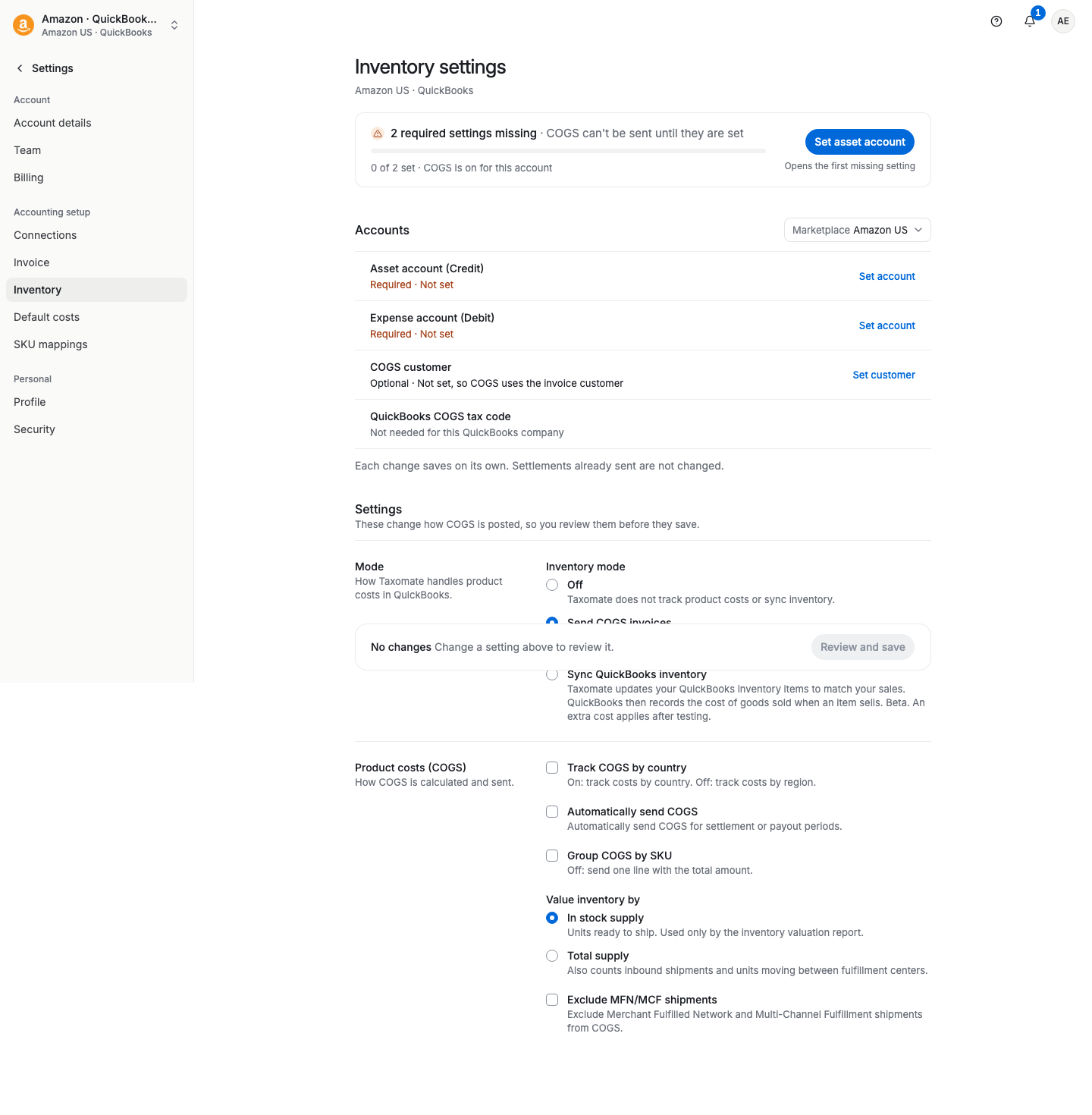
Under QuickBooks products (QuickBooks inventory for eBay, Etsy, Shopify and Walmart), choose whether Taxomate creates your products from Amazon, eBay, Etsy, Walmart, or Shopify in QuickBooks for you. Turn on Automatically create inventory products to let Taxomate do it. If you leave it off, map each product yourself (see Step 4 below).
You can also turn on Automatically create item classes. If you leave it off, map classes yourself. Your QuickBooks plan must support the classes.
Note: The system may take a few hours to create the products in QuickBooks.
Under Sales and refunds, choose one option for How sales change stock. Taxomate uses only one option, so a sale never lowers stock twice.
One inventory adjustment per settlement: each settlement sends one QuickBooks inventory adjustment with its entry. It works with journal entries and with sales invoices.
Products on sales invoices: each invoice line uses the SKU's QuickBooks product. QuickBooks lowers stock and records the cost when it saves the invoice. You can choose this only when settlements post as sales invoices, grouped by SKU or Orders (Settings > Invoice).
FBA shipment and return events: Taxomate changes quantities from the Amazon inventory ledger, on the day of each event: completed deliveries of orders that Amazon fulfilled, and customer returns that went back into your inventory. Taxomate does not record cost of goods sold for these changes. For now, Taxomate holds these events (see "Other FBA events" below).
Do not change stock for sales: you record sales against QuickBooks stock yourself.
Choose One inventory adjustment per settlement.
Choose an Inventory adjustment account. It must be a Cost of Goods Sold account. Taxomate uses it for all marketplaces.
Turn on Exclude MFN/MCF shipments if you keep merchant-fulfilled stock outside QuickBooks.
Select Review and save. Taxomate turns off the other ways that a sale lowers stock.
Each adjustment lowers each mapped product by the units sold in the settlement. It has the same date as the settlement entry. QuickBooks sets the cost of the units and records it in the inventory adjustment account.
This applies to settlements that you send after you save. Earlier settlements do not change QuickBooks stock. To include an earlier settlement, delete its entries, then send it again.
A refund does not return a unit to stock. When a customer return goes back into your sellable FBA inventory, Taxomate adds the unit back in QuickBooks with one inventory adjustment for that day, dated the day of the return. It adds back returns from the day you turned on this option. Returns that Amazon marks as damaged or defective are not added back. If a SKU has no QuickBooks product, its returns are not added back, and Taxomate tells you which SKUs to map.
To see what a settlement sent, open the settlement and select the Inventory adjustment tab. It shows the units sold, the units refunded and the stock change for each SKU. The settlement history shows the QuickBooks Inventory Adjustment. To remove the adjustment, delete the settlement's entries. QuickBooks must be connected. If it is not, Taxomate asks you to reconnect QuickBooks first.
Taxomate does not send the settlement when one of these problems exists. The message tells you what to do:
A SKU has no QuickBooks product, or its product is inactive or does not track quantity. Map the SKU on Settings > SKU mappings. If Automatically create inventory products is on, Taxomate first waits up to one day for its daily product sync to create the product. If the product is still missing after one day, the message asks you to map the SKU.
Automatically create inventory products is on, a product has no purchase cost in QuickBooks, and its stock would go below zero. QuickBooks would then record $0 cost of goods sold. Enter the purchase cost on the product in QuickBooks, or enter its purchase bill, then send again.
A COGS entry for this settlement is already in QuickBooks. Delete it on the settlement's Cost of goods sold tab, then send again.
The inventory start date of a product in QuickBooks is after the settlement. Change the start date in QuickBooks.
Your QuickBooks books are closed for the settlement date. Move the closing date in QuickBooks.
Stock below zero. The settlement still sends. The settlement shows how many SKUs are below zero in QuickBooks. QuickBooks values those units at the product's last cost or its purchase cost, or at $0 when the product has no cost. Enter the purchase bill or the FBA receipt in QuickBooks, dated on or before the settlement end date. QuickBooks then corrects the cost of these units. If Automatically create inventory products is on, a product with no cost stops the settlement instead (see the list above).
Under Other FBA events, select the inventory events you want to track. These events change quantity only. Taxomate does not record a cost for them yet. Taxomate imports these events, and the shipment and return events, daily. For now, Taxomate holds them and does not change your QuickBooks quantities. Later it sends them to QuickBooks as inventory adjustments dated the day of each event.
FBA receipt: inventory received in shipments to Amazon's fulfillment centers. Leave it off if you enter purchase bills with products in QuickBooks, or stock is counted twice.
FBA warehouse transfer: inventory transshipped into and out of fulfillment centers.
FBA adjustment: adjustments to inventory for issues such as disposition changes, misplaced inventory, found inventory, and ownership corrections.
Taxomate can import events as far back as 18 months from the current date.
Note: If Taxomate creates your products in QuickBooks automatically, you can skip this step.
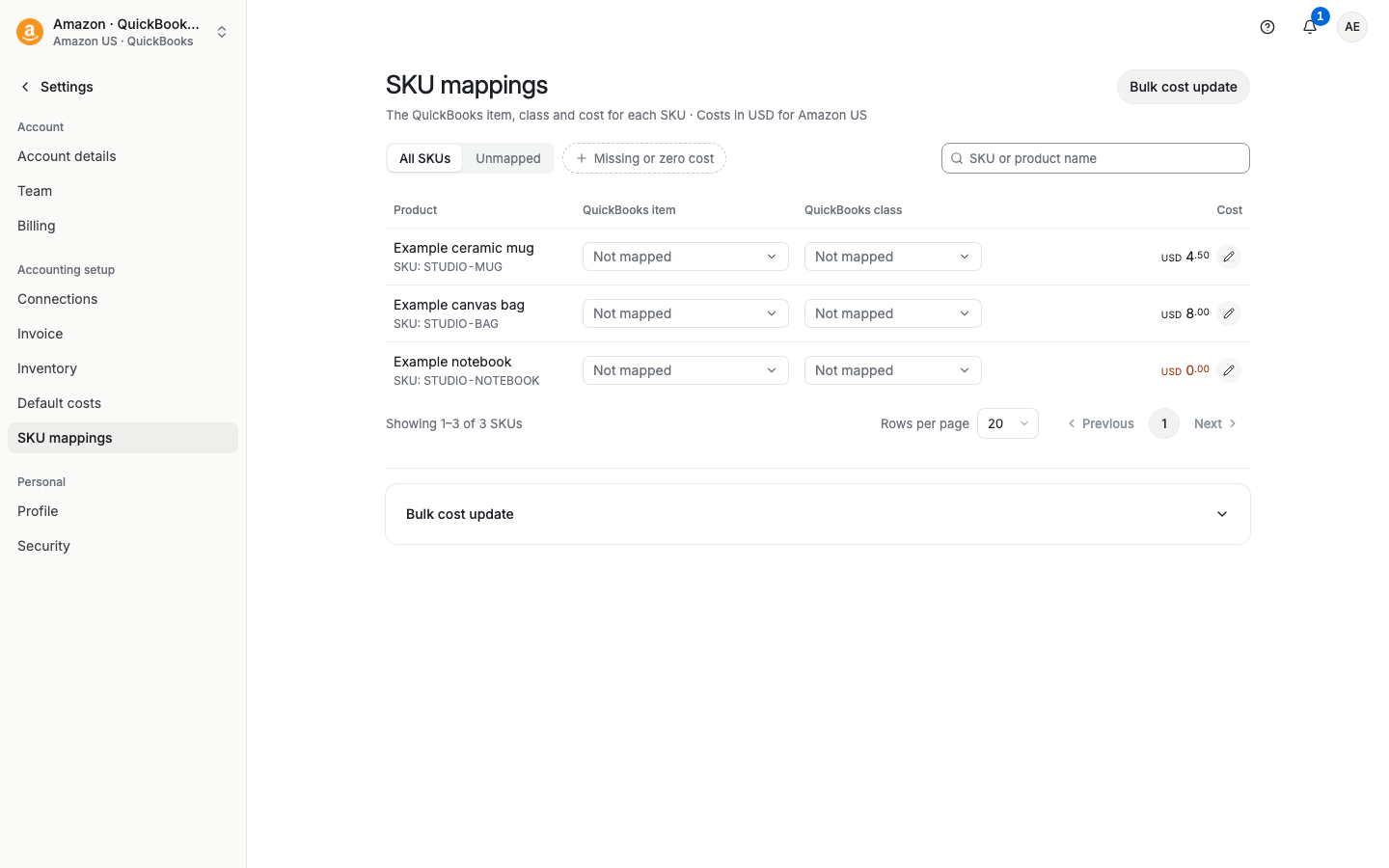
Go to Settings > SKU mappings. For each SKU, pick the QuickBooks item to match. If the SKU has no item yet, select Create QuickBooks item in the picker. Taxomate adds the item to QuickBooks and maps the SKU to it. Use Unmapped to show only the SKUs that still need an item.
My SKU shows in the description, not in the SKU field. Without inventory sync, Taxomate puts the SKU in the text of the invoice line. To tie the line to a QuickBooks product, turn on Sync QuickBooks inventory (Step 1), set Group sales by to SKU (Settings > Invoice), and map every SKU to a QuickBooks item (Step 4). Orders also works. Transaction types does not, because it adds sales together by category. Then rebuild the settlement and send it again.
A SKU has no QuickBooks item and the settlement still sent. A SKU with no mapped item does not stop the invoice. Taxomate puts that SKU on the default Product Sales item of your account. Open Settings > SKU mappings, select Unmapped to list the SKUs that have no item, and map them. This changes later settlements and settlements that you rebuild. It does not change an invoice that is already in QuickBooks.
I mapped a SKU to the wrong item. Change the item on Settings > SKU mappings. Invoices that are already in QuickBooks do not change. To fix one, delete the entry (see "Delete, archive or mark as not posted"), rebuild the settlement and send it again. If the QuickBooks entry is matched to a bank transaction, unmatch it first. Ask your accountant before you change closed periods.
A product was archived in QuickBooks. QuickBooks says: "You need to activate this item before updating the quantity." A SKU is mapped to an item that you archived or deleted. In QuickBooks, make the item active again, or map the SKU to another item on Settings > SKU mappings. Then send again.
Costs are $0. Use the Missing or zero cost filter on Settings > SKU mappings. With inventory sync, QuickBooks works out the cost of goods sold from the cost on the QuickBooks item. A cost change reaches an invoice only after you delete the invoice, rebuild the settlement and send it again. Settings > Default costs is hidden in this mode.
You can also add a cost for each product in Taxomate, and we update the cost for that SKU in QuickBooks. On Settings > SKU mappings, edit the Cost column, or select Bulk cost update. Settings > Default costs is not available in this mode. We also use these costs for the Inventory valuation report in Taxomate (Analytics > Inventory valuation).
Note: Taxomate holds Amazon FBA inventory events for now. See Step 3.
